
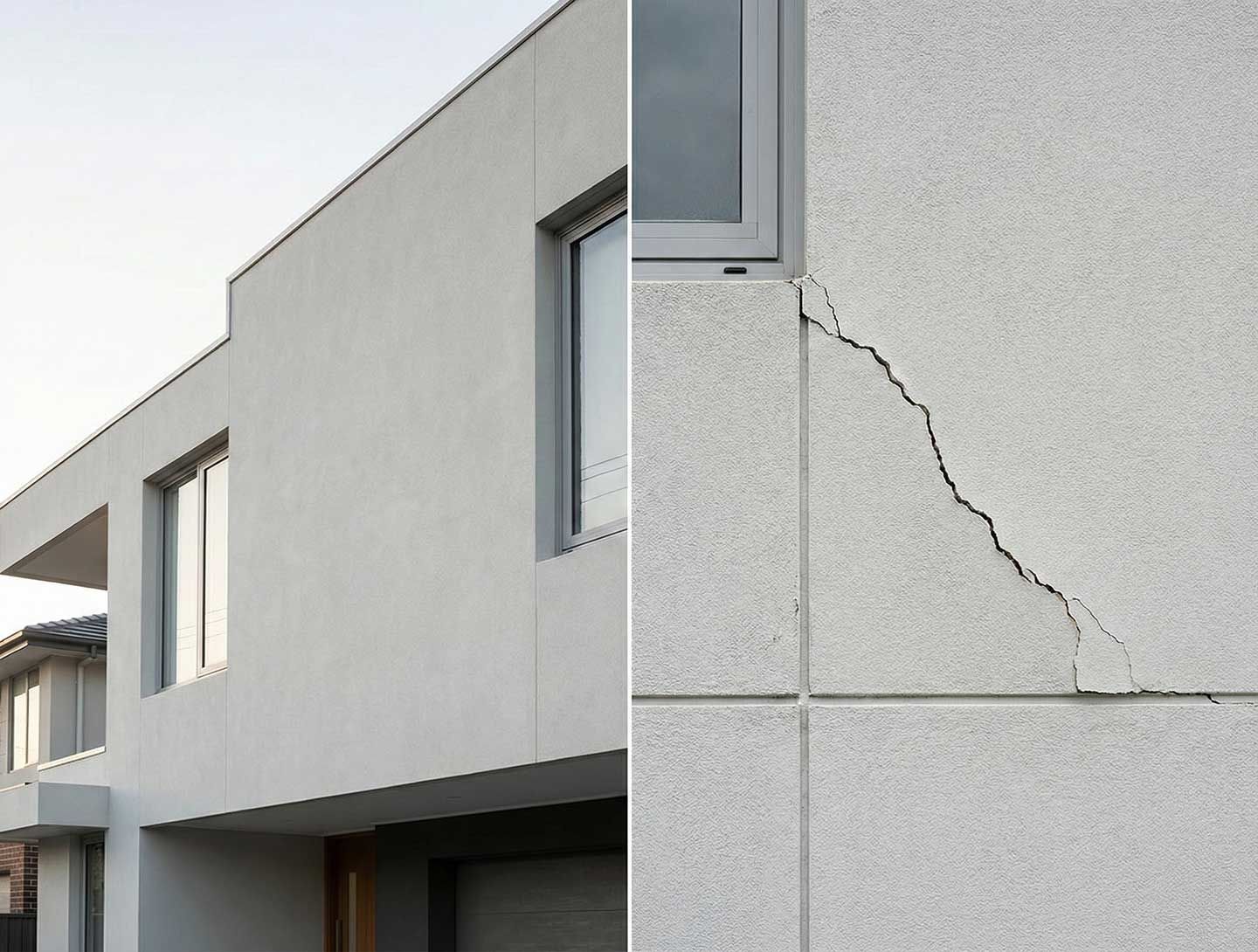
You've just spotted cracks snaking across your rendered walls. Your stomach drops. Is the house falling apart? Did your builder cut corners? Is this going to cost a fortune to fix?
Take a breath. In our experience across hundreds of Sydney projects, about 90% of the cracking we get called out to inspect turns out to be cosmetic rather than structural. That doesn't mean you should ignore it—but it does mean you probably have time to understand what's happening before making any decisions.
| Note: While we use "Hebel" throughout this guide (it's what most Sydney homeowners search for), everything here applies equally to Nasahi panels and Orangeboard (EPS) systems. The render behaves the same way regardless of what's underneath it. If you've got rendered lightweight panels on your home, this guide is for you. |
At Corebuild Services, we've installed Hebel and Nasahi systems on hundreds of homes across Sydney and NSW. We've also been called in to fix problems caused by others—so we've seen what goes wrong and why. This guide shares what we've learned.
| Quick Navigation: |
The 3-Second Check: How Serious Is Your Crack?
Before reading anything else, go outside and look at your crack. Use this traffic light system to get an immediate read on the situation.
| 🟢 GREEN (Monitor Only) | Hairline Cracks What you'll see: Fine lines thinner than a credit card edge. Random pattern, not following any particular direction. Verdict: Normal settling and shrinkage. Every building moves slightly as it adjusts to its environment. Action: Keep an eye on them. If they bother you visually, a quality exterior membrane paint will cover them. |
| 🟡 YELLOW (Needs Attention) | Cracks at Corners and Joints What you'll see: Straight lines (1-3mm wide) near windows, doors, or where the wall meets the roofline. Often vertical. Verdict: Typically an Expansion Joint issue. The building is moving, but the render wasn't set up to move with it. Action: Needs professional repair to prevent water getting behind the render. Your house isn't falling down, but ignoring this will lead to bigger problems. |
| 🔴 RED (Call a Professional) | Wide or Growing Cracks What you'll see: Cracks wider than 3mm (can fit a coin). Or the render sounds "hollow" when tapped. Verdict: Structural movement or adhesive failure (delamination). Water is likely already getting in. Action: Get a professional inspection promptly. This is not a weekend DIY job. |
What's Actually Causing Your Cracks?
Here's something most homeowners don't realise: Hebel panels themselves rarely crack. What cracks is the render system applied over the top. Understanding this distinction matters because it points to the real cause.
1. Missing or Covered Expansion Joints (Most Common)
Every building moves. Sydney's climate swings cause thermal expansion. Expansion joints act like the gaps in a concrete footpath—allowing movement without cracking. If your renderer skipped cutting these joints (or rendered over them), cracks will appear exactly where the wall wants to move.
Red Flag: If your builder says they'll "fix it with silicone," be careful. Silicone over an uncut joint is a temporary band-aid. The movement will rip it open again.
2. Wrong Render System
Hebel and Nasahi panels require flexible acrylic render. Traditional cement render is too rigid and will crack on lightweight panels. Always ensure your installer uses a system from the approved coating list.
3. Foundation Movement (Western Sydney)
Sydney sits on varied geology. Parts of Western Sydney (Penrith, Blacktown, Liverpool) have reactive clay soils that swell when wet. This can cause diagonal cracks running at roughly 45 degrees from window corners.
Troubleshooting Table: What Caused My Crack?
| If you see this... | It usually means... | The Fix |
| Straight vertical line (floor to ceiling) | Missing Expansion Joint. The builder didn't leave room for the wall to expand in the heat. | Call Pro. Needs a joint cut and re-sealed. |
| Spider web pattern (all over) | Dried Too Fast. The renderer likely worked on a hot day or didn't cure it properly. | Cosmetic. Can often be fixed with high-build paint. |
| Diagonal crack (45° from window) | Foundation Movement. Common in Western Sydney's reactive clay soils. | Engineer Check. Rule out structural issues first. |
| "Stair-step" crack | Settlement. The blocks underneath are shifting slightly. | Call Pro. Needs flexible reinforcement and patch. |
The "Am I Safe?" Flowchart
- Can you fit a $2 coin in the crack?
- YES → 🛑 Stop. Get a professional inspection.
- NO → Continue.
- Does the wall sound "hollow" when you tap near the crack?
- YES → 🛑 Stop. The render has de-laminated. Call a professional.
- NO → Continue.
- Has the crack grown noticeably in the last 6 months?
- YES → ⚠️ Active movement. Investigate cause.
- NO → ✅ Likely stable. Safe to patch and paint.
[Image Placeholder: Insert Flowchart Decision Tree. Alt Text: Flowchart decision tree for assessing hebel wall cracks safety]
The Real Cost & The Warranty Trap
"Can I just leave it for now?"
You can, but water is the enemy. A hairline crack is fine, but a crack at a joint allows water behind the system. Over 1-2 years, this causes the render to bubble and the steel/timber frame to rot.
Protect Your Warranty Rights (NSW)Builders often tell homeowners to "wait 12 months for the house to settle" before fixing cracks. Be careful.
Pro Tip: If your builder asks you to wait, lodge a formal written defect notice before the 2-year mark. If you wait too long, you may inadvertently waive your right to a free repair. |
Can You Fix It Yourself?
DIY-Appropriate Cracks
You can tackle this if the crack is hairline (<1mm), not at a joint, and the wall sounds solid. Use a quality flexible exterior filler (like Selleys) and finish with a membrane paint like Dulux Weathershield.
When to Call a Professional
Call us if cracks are wide (>2mm), located at expansion joints, or making a hollow sound. Professional repair involves cutting proper expansion joints, reinforcing the area with mesh, and re-applying the correct acrylic render system.
Prevention: 3 Questions to Ask Your Builder
Building a new home? Don't let this happen to you. Ask your builder these three questions before rendering starts:
- "Are you cutting expansion joints the SAME DAY you render?" (If they wait until it dries, it's too late).
- "Are you using an acrylic (flexible) render system?" (Cement render is too rigid).
- "Is your Hebel installer CSR Accredited?"
Frequently Asked Questions
Q: Is cracking in Hebel or Nasahi normal?
A: Minor hairline cracking (<1mm) is common as new homes settle. However, wide cracks or cracks at corners often indicate missing expansion joints, which is an installation defect.
Q: Does Hebel crack more than brick?
A: No. AAC panels are flexible. The issue is usually the render, not the panel. If a builder uses rigid cement render instead of flexible acrylic render, it will crack.
Q: Can I just silicone the cracks?
A: Silicone is a temporary "band-aid." It stops water for a while, but it doesn't fix the underlying movement. If you have an expansion joint issue, the movement will eventually rip the silicone open.
Q: Is cracking covered by warranty?
A: Panels have long warranties (20+ years). Render application is covered by your builder's statutory warranty (2 years for minor defects, 6 years for major defects). Document cracks immediately.
Need Professional Remedial Work?
If you've used this guide and determined that your cracking is more than cosmetic, you likely need professional remedial work.
At Corebuild Services, we specialize in rectifying failed Hebel and Nasahi render systems. We don't just patch over the problem—we fix the root cause by cutting proper expansion joints, reinforcing the render, and ensuring your home is watertight.
Don't let water damage spread. If you are ready to get it fixed properly, we are ready to help.